Thursday, 17 October 2013

What Scale Do You Sing In?


If you sing Rabindrasangeet like, oh, say 85% of all Bengalis, then this is the first question your musical accompanist will ask you. If you ask him/her to elaborate, you’ll hear something like, “Yes, what’s your scale? Is it A or B-flat or C-sharp or.. ?”

“Setting the right scale” is of paramount importance in the “chorus” songs where men and women sing together, usually accompanied by much grumbling from the women that  “The men are singing way too high”.

At this point, anybody trained in Western classical music – where the concept of a scale comes from – will be scratching their heads in perplexity.
To begin with, things like B-flat and C-sharp are not scales – they are musical notes.
As for “men singing too high”….. well, just keep reading….

What follows is “original research” -  the pieces are all there, but based on my conversations, what I am about to say is certainly not common knowledge among Indian singers.
Western singers and musicians use the nomenclature of scales and so on, but the words are used quite differently in the Indian music context, resulting in much unnecessary confusion when talking “across cultures”.

So, let’s first get the language straight. 

Every note in music corresponds to a certain pitch or frequency, measured in Hertz (Hz). A higher frequency gives a higher note.
Musicians, however don’t refer to notes by frequency (too unromantic, I guess), but give them names as we shall see below.

Absolute Notes on a Piano


Take a look at the image of a piano keyboard. Each key sounds a note when pressed.

The white key on the extreme left is A0 (pronounced “A  zero”).
It corresponds to a frequency of 27.5 Hz, which is very close to the lower limit of human hearing (around 20 Hz). In fact, if someone plays an A0, you pretty much feel it as a vibration rather than hearing a sound !
The second white key from the left is B0, with a frequency of 31 Hz (still really low).

But we start our analysis with the third white key from the left.
This is C1 (“C one”) with a frequency of about 32.75 Hz.
The 7 successive white keys starting with C1 are: C1, D1, E1, F1, G1, A1 and B1.
The next white key is C2 (“C two”) and the cycle starts all over again with C2, D2 and so on.

The eight notes going from C1 to C2, form an octave. Every note in the octave has a fixed relative frequency to the other notes. For example, G1 is about 1.5 times the frequency of C1.
Most importantly, C2 has exactly twice the frequency of C1.
Similarly, D2 is twice the frequency of D1 and so on. (Also, A1 is twice the frequency of A0).
Now the cycle of keys just keeps repeating as you move from left to right – with C3, D3, etc, then C4, D4, etc – until you reach the extreme right of the keyboard.

That final white key is C8.
With a frequency of approximately 4192 Hz, it is well beyond the reach of any human voice. (But nowhere near the limit of human hearing, which goes up to 20,000 Hz)


So much for the white keys. What about the black ones ?
Firstly, note that every black key lies between two white keys.
The nomenclature formula is simple – If X is the white key immediately to the left, then your black key becomes “X sharp” (written “X#”),  if Y is the white key immediately to the right, then your black key becomes “Y flat” (written “Yь”).

The first black key from the left lies between A0 and B0.
Using our formula, it would therefore become A#0 (“A sharp zero”) or Bь0 (“B flat zero”).
Similarly, we have notes like C#1, Eь3 etc.

Two points to note here:
- The ordering of the keys starts with C. Hence, A1 and B1 are higher notes than C1 or G1, but lower than C2 or D2. (This is what happens when you leave nomenclature to musicians rather than scientists J)
- The sharp and flat notation has considerable overlap.  C sharp is the same as D flat, B flat is also A sharp and so on. Which name is used depends purely on convention.

Exercise for the reader:
Rank the following in ascending order of pitch: C4, B3, G#3, A4, Eь4, D5

I hope this clarifies why I said that B flat and C sharp are notes rather than scales.  In fact, one needs to be even more specific and pinpoint which C sharp you are talking about.
This is, in fact, what happens in Western classical music.
When a pianist plays, say, the Moonlight Sonata, the musical score specifies exactly which notes she needs to play.
I will call these absolute notes, as each note corresponds to a specific frequency.

Western musicians often talk about “middle C”. This is simply C4, near the centre of the keyboard, and having a frequency of about 262 Hz.
The notes around C4 are most frequently used in vocal music as they fall into the “comfort zone” of the human voice.

Relative notes in Indian music

A Western classical musician trying to learn Indian music starts off with complete confusion.
To begin with, the concept of notes seems to be absent.

Her guru will frequently allude to the Sapta Soor (“Seven Notes”) – Sa Re Ga Ma Pa Dha Ni
In fact, people will often explicitly speak out the names of these notes while singing.
But there is no straightforward mapping from these onto the notes on a piano.
Even worse, different singers will sing out the same sequence of  Sa Re Ga Ma, but the actual notes they sing (as per piano), may be quite different !


After a while, however, the bewilderment begins to abate.
She observes that the relative pitch of the Sapta Soor notes remains fixed although the absolute notes being sung may change.
In fact, if she is familiar with the Sound of Music movie, she quickly realizes that Sa Re Ga Ma Pa Dha Ni corresponds precisely to Do Re Mi Fa Sol La Ti  J
(You see, Indian music is starting her off at the very beginning…)

Swaralipi in Rabindrasangeet

So, Sa Re Ga Ma Pa Dha Ni  spans an octave. But what if you want to go higher ?
Well, just like the notes on a piano cycling back to C, when you want to climb higher than Ni  in Indian music, you get back to Sa. Only it’s a “high Sa”. I will call this Sa*.
Just like C2 and C1, the high SaSa*, corresponds to a note with twice the frequency of the ordinary Sa
(But which notes are they on the piano ?? Patience, patience…)

Now you can continue upwards with Re*, Ga* and so on.
Similarly, if you want to go lower than ordinary Sa, you have Ni* , Dha* , (“low Ni” and “ low Dha”) which are half the frequency of the ordinary Ni and Dha.
Indian vocal songs – and especially Rabindrasangeet – typically span a maximum range of two octaves, so in terms of Indian musical notation, you rarely climb above Pa* (“high Pa”) or go lower than Pa* (“low Pa”).
However, in any given song, the bulk of the notes will lie within the “ordinary notes” – i.e. between Sa and Sa*.

Now to illustrate the crucial difference between absolute and relative notes:
Suppose you are a western choir singer. Your music score requires you to sing C4, D4, E4 and F4
Instead you sing C3, D3, E3, F3.
Your choirmaster immediately hauls you out for singing out of tune.

Now in Indian music school, three singers are going to sing Sa Re Ga Ma.
Singer 1 hits the notes - C4, D4, E4, F4
Singer 2 goes - C3, D3, E3, F3
Singer 3 sings - A3, B3, C#4, D4

To your surprise, the guru is perfectly happy with all three!
“They are just singing in different scales”, he says.

Scales again! What on earth are these pesky scales?
Well, with all this background on absolute and relative notes, we are finally ready to answer the question.

What scale do you sing in?

Here’s an example of a scale in Western music – it’s called “C Major”.
It consists of the notes: C D E F G A B
Another one is "B Minor"
It consists of the notes: B C# D E F# G A

What the … ??!! What about scales like B flat, G sharp and so on?
Now the Western musician gives you a blank stare – “Those are not scales. Those are notes.”

A scale in Western music is a collection of notes.
Vocalists and musicians practice singing/playing these notes to perfect their technique.
Occasionally, you’ll see things like “XYZ Symphony in C Major”.
What it means is that XYZ Symphony only has notes from the set of notes in the scale.
So, you may have a C5 note somewhere in the score, but never a F#3.

In that sense, a scale is somewhat like a raga in Indian classical music, although the rules of a raga are somewhat more elaborate.

But then, what are Indian musicians talking about when they mention scales ?

Well, recall that the Sapta Soor of Indian music only defines relative pitches.
However, once you specify the absolute note corresponding to any one of the Sapta Soor, all the other notes become uniquely determined.

So, if you had to sing Sa Re Ga Ma and you set Sa to be the note C4, then you get C4, D4, E4, F4.
If you set Sa to A3 instead, you get A3, B3, C#4, D4 instead.

And that’s what the whole deal is about.
Your accompanist needs to know what absolute notes to play, and for that, all he needs is what piano note your Sa (ordinary Sa, not the high Sa) corresponds to.

So, here’s the dictionary translating the most popular “scales” in Rabindrasangeet to notes.

Scale                       Piano note corresponding to Sa (ordinary Sa)
G Sharp                    G#2 or G#3
A                                  A2 or A3
B Flat                         Bь2 or Bь3
B                                  B2 or B3
C                                  C3 or C4        (C4 = Middle C = 262 Hz)
C Sharp                     C#3 or C#4

(Just to irritate you further, the scale B Flat is often called “B” in Bengal and B is called “natural B”. This is just idiotic terminology. Please, people, there are no natural versus unnatural Bs, just good old B and B Flat.)

But wait, hang on, why the “A2 or A3” and so on? Why not just A3, say?
This brings us to the final question in this post.

Do men really sing high?

“Definitely yes”, answers the Rabindrasangeet singer.
In fact, it’s something he’s known since his early days in singing school - “Men always sing the higher notes in choruses and generally sing at higher scales.”

“No way”, responds the Western choir singer. “In fact, it’s the women who sing the high notes and the men who sing the low notes. Ask any choirmaster.”

The laws of physics concur.
Humans sing by vibrating their vocal cords. Men have longer and thicker vocal cords than women. Now, a vibrating string which is longer and thicker generates lower frequency sounds.
Hence, men must sing at lower frequencies – i.e. men must sing the lower notes. QED.

So, what’s going on in Indian music?
As a youngster learning Rabindrasangeet, this question puzzled me greatly – especially the contradiction between who sings the high notes in Indian versus Western music.
My music teachers in India brushed me off with an impatient, “Oh, that’s because Indian music and Western music are completely different.” (Nonsense !)
And of course, nobody understood the argument from physics.

But, now I do know the answer.
And if you have been trained in Indian music, you very probably don’t – so listen up!!

In Indian music, when men and women sing together, they are NOT singing the same notes (in the sense of absolute notes).
In fact, every note the woman is singing is one octave higher – i.e. twice the frequency – as that being sung by the man !


Knowing this immediately explains everything.
To begin with, the laws of physics aren’t being violated and the choir singer is correct – it is, in fact, women who sing at higher frequencies.

So, why are the women in India complaining about men singing too high ?
The reason is actually very interesting.
It seems that a typical woman’s voice is pitched at about 1.5 times a typical man’s.
In other words, if a typical man’s singing frequency range goes from X to Y, a typical woman’s range goes from 1.5 X to 1.5 Y.

But, in Indian music, the woman must sing at twice the frequency of a man.
So, if the highest frequency the man can hit is Y, the woman must hit 2Y rather than 1.5Y, which is of course, extremely hard on her voice, if not outright impossible.
Similarly, a man will find it difficult to sing along when the woman sings her lowest notes.
Thus, in an amusing inversion of the Western choir, the “high parts” in Indian vocal music are left to the men, when in fact, they are actually singing low!

So, ladies, don’t grumble in future about “men singing too high”. We really aren’t.
It’s just that, apparently, evolution didn’t intend men and women to sing in harmony. J

Finally, to explain the ambiguity of “A2 or A3” in the scale-to-note translation dictionary.
As you may have guessed, it’s due to the fact that men and women are singing different notes.
Hence, when “setting the scale”, the Sa must correspond to different notes depending on the gender of the singer.

Here’s the completed dictionary which adds in that bit.

Scale                       Piano note corresponding to Sa (ordinary Sa)
G Sharp                    G#2 (men) or G#3 (women)
A                                  A2 (men) or A3 (women)
B Flat                         Bь2 (men) or Bь3 (women)
B                                  B2 (men) or B3 (women)
C                                  C3 (men) or C4 (women)       (C4 = Middle C = 262 Hz)
C Sharp                     C#3 (men) or C#4 (women)


So, where do you go from here ?
Well, you can start by testing some of the things I said by connecting to this virtual piano
The key marked with a red dot is C4. The first key marked C to the left of that is C3.
Try playing the notes and matching them vocally. For best effect have a singer of the opposite gender with you. Its a real eye opener. J

PS: I’ve used the words Indian music and Rabindrasangeet interchangeably. This is, of course, inaccurate. Indian music has enormously many branches with Rabindrasangeet being just one.
However, from my experience, the usage of “scales” as I have described and the myth that “men sing higher than women” persists across all branches of Indian music I have encountered, including Hindustani and Carnatic classical music.


Wednesday, 30 January 2013

Govinda - Book Review


The least appealing aspect of the Mahabharat, I feel, is the intrusion of the divine.
The marvelously multifaceted narrative is, in my opinion, severely compromised by the heavy-handed attempt to present it all as a good-versus-evil morality tale orchestrated by God Himself in the form of Sri Krishna.
It’s not just that I find the idea of an avatar rather ridiculous. It also makes for lousy fiction.
An arrogant and cocksure God-in-human-form, always slated to come out on top with smug smile on face and pithy proverb on lip, makes for an unappealing character at best, while ruining any element of suspense in the story.

What if the Mahabharat were presented as historical fiction without any attempt to inject a “moral of the story”? What if Krishna was just a man among others, struggling to shape his destiny amidst the forces of his time, rather than achieving it all by effortless divine will?
To get a flavor, look no further than “Govinda”, first book of the “Aryavarta Chronicles” by debutante author Krishna Udayasankar.

The geographical backdrop of the novel is Aryavarta, the northern half of the Indian subcontinent in the second millennium BC. The historical setting is a deadly conflict between two groups of Brahmins.
On one side are the Firstborn, scholar and sages, upholders of sacrificial rituals and social norms, makers and breakers of kings. Opposed to them are the Firewrights - master scientists, inventors, and iconoclasts.

When Firewright technology gone awry dries up the Saraswati river - turning a fertile kingdom to barren desert - the Firstborn seize the opportunity to launch the Scourge. With the active support of the ruling nobility, Firewrights across the nation are mercilessly tortured and killed. Some survivors go into hiding; others seek refuge with kings who are willing to surreptitiously exploit their expertise to manufacture lethal weapons.
One such is Jarasandha, king of Magadha, gradually extending his sway over Aryavarta in a bid to become Emperor. Other kingdoms, including the Kurus and Panchalas, officially acknowledge his sovereignty, while secretly seeking to counterbalance his power.

Into this landscape of intrigue steps the character of Govinda Shauri – the author’s preferred name for Krishna. Arisen from humble origins as a gwala (cowherd) to become king of Mathura, he has since abandoned his kingdom in the face of Jarasandha’s attacks to establish an outpost at Dwarka on the southwestern edge of Aryavarta. This act of “dishonor” has earned him the eternal contempt of the ruling Kshatriya nobility who are already ill-disposed to accept him as an equal due to his cowherd past.

The Firstborn, however, see him as a convenient pawn in their bid for supremacy. In the past, Govinda has been instrumental in the success of the Scourge. His enmity with Jarasandha makes him the perfect foil to the would-be emperor and last refuge of the wrights. As Vyasa, leader of the Firstborn, tells his disciples, Govinda is a “tiger who needs to be tamed” to their service.
A resourceful politician and wily warrior, Govinda is happy to aid Vyasa’s efforts.
But there are hints of a deeper, darker plot in the background, a plan which makes even his brother and friends uneasy…

Udayasankar wields her prose deftly, drawing you swiftly into the story and holding your interest thereafter.
In her hands, the Mahabharat takes on a darker, grittier aspect.
This is no tale for children with the reassurance of a happy ending.
Prisoners are brutally tortured and executed, ruling classes treat commoners with contempt and derision, women are marginalized and restricted – especially in the Kuru kingdom.
Bad things can, and do, happen to good people.

While the characters are all from the Mahabharat, those familiar with the epic only through Amar Chitra Katha or teleserials may find themselves at a loss.
Characters are referred to by unfamiliar alternate names found in the epic. Yudhisthira is Dharma, Arjuna is Partha, Duryodhana is Syodhana, Karna is Vasusena and so on

A number of characters are presented in a refreshing new light.
Dharma (Yudhishthira) – complex and self-serving, forever trying to project an image of righteous otherworldliness while hungering for personal glory, disguising his bids for power as burdensome duties he must take on for the greater good.
Syodhana (Duryodhana) – peace-loving family man, increasingly dismayed to find himself cast in the role of villain by Yudhsthira’s machinations.
Shikhandin (Shikhandi) – a guerilla warrior par excellence, maligned as a coward because he refused to blindly condone his father’s actions.
Panchali (Draupadi) – Intelligent, thoughtful and every bit as fiery as her epic counterpart, she takes a very active role in the politics of the day, far beyond merely goading her husband/s into action.

Finally, there is the fascinating Govinda Shauri (Krishna).
Charismatic, charming, unfailingly polite and kind to everyone around him.
Yet, at the same time, strangely detached and dispassionate, willing to manipulate or sacrifice loved ones and unleash great suffering to achieve a desired end.
An intriguing persona indeed - far more so than the annoying Bhagwan Sri Sri Krishna we usually encounter.

In summary, I heartily recommend Govinda. Can’t wait for the next book to come out.

Friday, 6 July 2012

The Higgs Boson


On 4th July 2012, Rolf Heuer, director of CERN, announced that the Higgs boson had been discovered. The packed auditorium of scientists and reporters erupted in applause, cameras flashed and history was made.
A few hours later, Googling “Higgs boson found” gave 262 million results. Replacing “Higgs boson” by “God particle” gave many million more.

So, what is the Higgs boson, what does it mean for physics, and where does God come in?

The Layman’s Picture  
To start the story, let’s roll back 80 years.
In 1932, the discovery of the neutron completed what I call the Layman’s Picture of the universe familiar nowadays to anyone with a high school education (if they haven’t slept through all their science classes, that is…).

In this picture, all the “stuff” in the universe, aka “matter”, is made up of atoms, which are themselves composed of protons, neutrons and electrons.
All matter is subject to the force of gravity which shapes the stars and galaxies.
If, in addition, the matter has a charge, it also feels the forces of electricity and magnetism.

Nearly 70 years before our story begins, James Clerk Maxwell had shown that electricity and magnetism were two aspects of the same force, henceforth called electromagnetism. This was the first of the so called “unifications of physics” and as a stunning consequence was that light was revealed to be an electromagnetic wave – a disturbance of the electromagnetic field that propagates through space like waves through water.


The three decades, 1900 to 1930, had witnessed possibly the most spectacular advances ever in theoretical physics.
On the one hand we had Einstein’s theories of Relativity. Special Relativity reconciled Maxwell’s theory with mechanics in a revolutionary way – among the implications was the equivalence of mass and energy (yes, E = mc2). General Relativity subsumed special relativity and revealed gravity an effect of the curvature of space and time in the presence of matter and energy.
On the other hand, the theory of Quantum Mechanics, developed by a group of physicists in the 1920’s had incredible success explaining the world of atoms and molecules. This theory came with its own baggage of bizarreness – wave-particle duality, the Uncertainty Principle and more.

Many intellectuals believed that our picture of the world was essentially complete. All that remained was to unify gravity with electromagnetism and Einstein was already working on it.
The truth would turn out to be far stranger…

The Standard Model
Fast forward to the late 1940’s.
The terrifying potential of nuclear power had engendered  interest in peering even deeper into the fundamental constituents of matter – after all who knew what mightier sources of energy were waiting to be tapped ?
This was the age of the great particle accelerators – huge machines that accelerate atoms to extremely high velocities and smash them together.

The hope was to reveal even simpler ingredients underlying protons and electrons.
What ensued instead was complete chaos. Instead of a few simple components, the accelerators turned out a profusion of literally hundreds of new particles at an astonishing rate!!
Physicists despaired of ever making sense of the mess. Some speculated that rather than getting simpler, maybe matter gets ever more complex as one goes further down…

Then as the 50’s rolled into the 60’s, a picture began to emerge, and here it is:


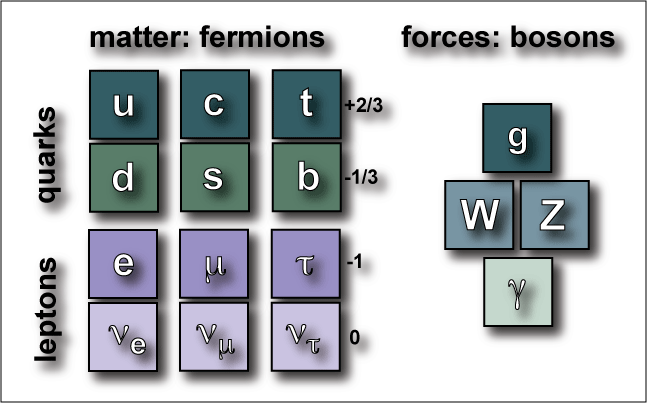
Welcome to the Standard Model. This is the best picture we have so far of the fundamental constituents of our universe.

To the left of the picture are the basic building blocks of matter.
You will notice that protons and neutrons are nowhere in the picture. That’s because they themselves are made of even more basic constituents – the quarks. Quarks come in 6 varieties – up, down, charmed, strange, top and bottom.
Electrons, however, are in the picture.
The “e” in the upper left corner of the group called “leptons” is the electron.
Along with them in the same row are the muon and the tau particle.
The bottom row on the left shows the 3 types of neutrino – strange, ghostlike particles than can pass through entire planets without leaving a trace.
Why these twelve? Why no more or fewer? Nobody knows.

The right side shows the “force particles”. Come again?
Well, the theoretical framework underlying the forces of nature is Quantum Field Theory (QFT).
In QFT, each force is represented by a “quantum field” pervading all of space. Associated with each such quantum field is a characteristic particle.
In the parlance of QFT, a matter particle “feels” a force if it is able to “interact with” or “couple to” the particle of the corresponding quantum field.
Just to make things fun, the force particles can even interact with each other, or even themselves. (This comes up later)

Clear? So now, the “γ” at bottom right is the photon, which is the particle corresponding to the electromagnetic force.
As for the rest – two new forces were discovered via all the particle smashing.
The strong nuclear force binds quarks together into protons and neutrons. Its particle is the gluon, which is the “g” on top right.
The weak nuclear force is responsible for radioactive decay and its particles are the W and Z in middle right.

[A diversion:  You will notice that the “force particles” are called bosons. This is because all force particles share some commonalities that were elucidated in the early 1920’s by Bengali physicist Satyendranath Bose. So, all Bengalis reading this – enjoy your 2 seconds of reflected glory.]

But talking of forces, where’s gravity? Welcome to the biggest gap in the current foundations of theoretical physics. Despite decades of effort, nobody has come up with a successful QFT for gravity. Anybody who succeeds will usher in a new era of physics.
But we digress.

Another force particle is missing in this picture – missing because until very recently, nobody was sure it even existed. Enter the Higgs boson.

The Higgs Field(s)
Remember Maxwell joining electricity and magnetism together?
The quest to unite the forces of nature under a single description has been a prime motivator for theoretical physics over the last century.

Starting with Paul Dirac in the 1920’s, physicists managed to merge Maxwell’s theory with quantum mechanics to develop the spectacularly successful theory of Quantum Electrodynamics – the QFT for the electromagnetic field over the next several decades.
 (Heard of Richard Feynman? This was his biggest work.)

Why stop with electromagnetism? From the 1960’s onwards an ongoing effort was made to incorporate both the strong and weak nuclear force into the same framework.
But there was a problem.

The photon and gluon have zero mass while the W and Z particles of the weak force have mass.
Why is that a problem?
The reasons are extremely technical (here’s where a PhD in physics comes in handy).
Suffice it to say that the theoretical framework constrains the particles of all three forces to have zero mass. So, how to reconcile theory with reality?

But what if there’s another “force” – another quantum field pervading the world? Maybe the reason why the W and Z particles seem to have mass is because they feel this strange new force.


To make a very crude analogy, suppose you are doing experiments with marbles on a very smooth floor. You flick all the marbles with the same force. Some of them shoot off, while others roll away slowly and then come to a stop. How to explain this?

One possibility – they have different weights and respond differently to your flicking.
But here’s another – they all weight the same, but some of the marbles are made of iron, and there’s a powerful magnet behind you.
The iron marbles feel the magnetic field and the others don’t, hence the different reactions.
The explanation proposed for the masses of the W and Z is similar.
The mysterious field, analogous to the magnetic field of our example, is the Higgs field – first proposed by Peter Higgs in 1964.
The idea of a Higgs field was used to unify electromagnetism with the weak force by Sheldon Glashow, Abdus Salam and Steven Weinberg – a feat which won them a Nobel prize in 1979.

But now the bonus:
If interaction with the Higgs field can “give mass” to the W and Z particles, could it be the case that all particles derive their mass from the same mechanism?!
If true, this would mean that mass is not a fundamental property of matter – just a consequence of some particles “feeling the Higgs field”.

So, does this really happen?  Yes. If you believe the Standard Model
Why do different particles have different masses?
Nobody knows. The model says that a particle’s mass is proportional to how strongly it interacts with the Higgs, but that just pushes the question one step back.
Is there just one Higgs field or many? Nobody knows.

In fact, until a week ago, nobody was sure that there was even a single Higgs field.
A number of alternative theories had been proposed to explain the particle masses without any need for a Higgs – although all these theories have a bunch of side-effects.

So, how would one know if the Higgs field was just a figment of the imagination?
Answer: As mentioned above, every quantum field has an associated particle. The particle associated with the Higgs field is the Higgs boson. (Finally, we get to the title of the post!)
Detect the Higgs boson and you know the field exists.

And that’s what we did on July 4, 2012!

(Note: Strictly speaking I should say we detected a Higgs boson, and so there is at least one Higgs field. For all we know, there could be dozens of them.)

Stagnation
Okay, so if you’ve followed so far, we just verified a theory proposed nearly 50 years ago.
What’s the big deal? And how did we do it?
Answering the first question requires a bit of scientific history.

The late 70’s were a heady time for physicists.
The past six decades had been a period of unprecedented progress, leading us deeper than ever into the secrets of Nature.
The constant stream of insights and breakthroughs, it was felt, could only have one end – the Theory of Everything, unifying space, time, matter, energy and forces into one stupendously grand overarching framework.
Many – including the very outspoken Stephen Hawking – believed that this would happen by the turn of the millennium, bringing the Century of Physics to a supremely triumphant end.
What followed instead was three decades of massive stagnation.

String Theory, hailed as the most promising candidate for unification, degenerated into a thicket of wild speculation and unverifiable hypotheses. Currently, supporters claim that they have made great “conceptual progress”, while detractors argue that the theory is “not even wrong”, i.e. it can be tweaked arbitrarily to fit any observation.
On the experimental side, things ground to a halt with Congress refusing funding for more powerful particle accelerators.

Only the astronomers maintained an iota of progress, indicating that not all was well. Evidence steadily mounted, especially in the last decade, that the matter described by the Standard Model only constitutes about 15% of all the matter there is. Meanwhile, cosmology yielded a huge surprise – the expansion of the universe is accelerating and nobody knows what’s causing it.
But alas, no help was forthcoming from the theorists to explain any of this, lost as they were in the wild goose chase of strings…


For those not enamored of string-world, the easiest path beyond the Standard Model lay in the investigation of the Higgs field(s). This was the only feature of the theory which remained somewhat speculative, but concrete experimental data was needed to make headway.
Hence, all hope focused on the Large Hadron Collider, scheduled to start operating in early 2009 at CERN in Switzerland.

Discovery
The Large Hadron Collider (LHC) is the most powerful particle accelerator ever built.
Magnets of tremendous power accelerate beams of protons are along a circular tunnel 27 km long and smash them into each other with savage force. Hundreds of detectors track the debris that erupts and record its characterestics.

How does this help?
Well, quantum theory predicts that collisions of particles don’t just give you constituents of the things colliding. Completely new particles can arise, born out of the conversion of energy into mass. The higher the energy of collision, the higher the mass of the particle that may appear. (Remember, E = mc2).

[This, to my mind is one of the weirdest aspects of the quantum world. Imagine a situation where you smash two stones hard enough and a butterfly pops out and flies off. That is pretty much what goes on in these collisions!]

The hope was that the collision energy of the LHC would be sufficient to generate a Higgs boson.
But that would just be the beginning, because the Higgs could not be detected directly.
Instead, theory predicts that it would quickly decay into other types of particles.
So, the hope was to spot the relics of the Higgs rather than the particle itself.


To make matters even worse, the collisions at the LHC would generate zillions of other particles.
Thus, a Higgs that forms and quickly decays would only manifest as a slight excess of particles spotted at certain energies.
And finally, the Standard Model did not predict what the mass/energy of the Higgs boson would be. So, the experimenters would have to comb through a vast range of energy bands, looking for tiny excesses in the number of particles of certain types.
See the problem? Seeking a needle in a haystack is trivial by comparison.

But this is what was achieved!
In Dec 2011, after the LHC has run for about 2 years, researchers reported a slight excess of particles in the 120 to 130 GeV range.
(Gev stands for “Giga-Electron-Volts” and is a unit of energy. The mass of a proton is about            1 GeV, which is about 1.8×10⁻²⁷ kg)
But statistical techniques indicated this was only a “two sigma” result – there is a 2% chance of seeing something like this purely by chance. More work needed to be done.

Over the next 6 months, a massive effort was undertaken to scrutinize the mountains of data that had accumulated. Towards the last weeks of June, excitement rose in the scientific blogosphere. Rumors circulated that this was indeed the real thing. And so it was.


On July 4th, after months of speculation, the announcement was finally made.
Two separate sets of experiments had verified the existence of a particle with a mass of about 125 GeV.
In each case, the probability of a chance occurrence was “five sigma”– less than one in a million.
The Higgs boson had been found.

Dreams and Nightmares
So what does this mean for the future of physics?
Very different things, depending on whom you ask.

Optimists like cosmologist Sean Carroll believe that the Higgs only heralds the beginning of a series of discoveries by the LHC, ushering in a new dawn for physics.
But not everyone agrees.

Detractors argue that all the properties of the Higgs discovered are completely consistent with the Standard Model which is nearly 40 years old. There is no hint yet of anything inexplicable, no trace of any new particles or phenomena, nothing to suggest the next step forward.
Maybe the only new physics occurs at much higher energies, way beyond what the LHC can probe and way beyond our technological capabilities.
This would be a physicist’s nightmare.

So, what shall it be? Dream or nightmare? Progress at last or stagnation without end?
Only time – and more data – will tell.

------x------

Afterword on the “God particle”:
This nickname for the Higgs boson was used by physicist Leon Lederman in a popular book on the subject. It remains, to date, the most egregious example of “God-mongering” to sell a popular science book, closely followed by Stephen Hawking’s “Brief History of Time”.
So just to be clear:
No, the Higgs boson has no religious significance or divine powers, and its discovery does not prove the existence of God.

Saturday, 4 June 2011

The Curious Case of Stephen Hawking

Countless newspaper articles compare him to Einstein.
Numerous others remind us that he held the Lucasian Professorship at Cambridge, “formerly held by Isaac Newton”. In an episode in Star Trek, he appears on the spaceship’s holodeck playing cards with both Newton and Einstein – and wins.
Clearly, in the echelons of scientific achievement, Stephen Hawking is at the pinnacle, with the greatest of the great.

Or is he really?
Let’s do a little comparison.

Newton can safely be called the father of theoretical physics.
While scientists like Galileo and Kepler underscored the importance of experiments and observations to understand the world, Newton pioneered the use of mathematical modelling to explain observed phenomena and predict new ones.
His most famous achievement was formulating his laws of motion, and the inverse square law of gravity which explained both the fall of an apple and the orbit of the moon and planets with unprecedented accuracy.
In the process, he also invented Calculus – undoubtedly the most influential branch of mathematics we have seen in the last five centuries.
Newton’s book, Principia Mathematica, triggered a revolution in human thought, revealing the universe as amenable to human understanding through mathematical laws.

In 1905, Einstein unified Newtonian mechanics with Maxwell’s theory of electromagnetism through his special theory of relativity, which made highly unintuitive, but completely correct predictions.
A decade later, he went even further, to create the general theory of relativity – a truly revolutionary theory that unified Newton’s law of gravity with special relativity by showing that gravity was the result of the curvature of space-time due to matter and energy.
General Relativity is one of the great pillars of modern physics, subsuming Newton’s laws of gravity and predicting a plethora of new phenomena – from black holes to the Big Bang.
Einstein also made very significant contributions to Quantum Mechanics, the other great pillar of modern physics. Most notably, he was the first to analyze light as a stream of particles rather than a wave.

Now for Stephen Hawking.
Fundamental areas of science established? None.
Influential new branches of math invented? None.
Any new fundamental particles predicted, as in the case of Paul Dirac? Nope.
How about a revolutionizing to an existing theory, like Richard Feynman? Not at all.
Don’t mean to rude or anything, but what has he done, then?

Two things, mainly.
In the late 1960’s, Roger Penrose proved a theorem to the effect that under certain conditions, general relativity predicts the occurrence of “singularities” – points in space where the laws of physics break down.
Hawking applied Penrose’s results to cosmological models, showing that under generic assumptions the point of origin of the Universe – the “moment of creation”, so to speak – is a singularity. Note that this is not a new theory, but a mathematical theorem derived from an existing theory (general relativity).

In 1974, Hawking proved the result which made him famous.
Using results from quantum field theory, he showed that black holes radiate energy and eventually evaporate. This created a huge stir, because black holes were by definition, objects from which nothing could escape, not even light. This was a strong indication that combining general relativity with quantum field theory could lead to unexpected results.
Hawking’s result has never been experimentally verified, but is accepted as true. Other scientists arrived at the same conclusion from a several different approaches, and the result explains a number of other theoretical issues in the field.

Impressive contributions? Certainly.
Worthy of a Nobel prize? Possibly.
Comparable to Newton and Einstein? Not by a very long run.
Then why is Hawking thus compared in the media? How has he gained a level of public prominence completely disproportionate to his actual achievements?
Why did his popular book, A Brief History of Time, top the New York Times bestseller list for three months straight, despite the fact that most readers claimed not to understand it?

Many think it is due to his physical condition which gets media attention– Hawking has been paralyzed by motor neuron disease since his early twenties.
In my opinion, the real answer lies elsewhere.

Grandiose Claims

Most great scientists are noted for their profound humility in the face of the universe.
The famous quote of Newton, comparing himself to a little boy playing on the shore of the ocean of knowledge comes to mind.
Now let’s hear Hawking:
“My goal is simple. It is a complete understanding of the universe, why it is as it is and why it exists at all.”

A simple goal indeed!! This is not an isolated statement.
In my view, audaciously grandiose claims like these play a key role in explaining Hawking’s arc to scientific superstardom.
While most popular science books are content to explore the wonders of the Universe and explain some of their workings, A Brief History of Time promises nothing less than an Ultimate Understanding – an answer to all the biggest questions ever asked my mankind.

In the book, Hawking claims that we are on the verge of a revolution in our understanding of the cosmos – not just any revolution, but the one to end them all.
We are on the verge of completing our quest to understand the ultimate laws of the universe, says Hawking. We will soon be in possession of a Theory of Everything – a grand unifying principle that subsumes all of physics and explains all features of the cosmos hitherto unknown, including the physical properties of all the fundamental particles, the forces and interactions between them and even the underlying structure of space and time.

What will follow thereafter is nothing short of intellectual Nirvana:
“If we do discover a complete theory.... we shall all be able to take part in the discussion of the question of why it is that we and the universe exist. If we find the answer to that, it would be the ultimate triumph of human reason — for then we would know the mind of God.”
A parenthetic claim – never directly made by Hawking, but widely inferred by the media and lay public – is that he would be the one to achieve this ultimate triumph of reason.


The grand vision promulgated by Hawking is, of course, vastly misleading.
Even if a unified theory of physics is found, its real applications will be primarily in esoteric realms far beyond the reach of experiment or observation, such the centres of black holes and the moment of the Big Bang. While this would certainly be impressive, the discussion of "why it is that we and the universe exist” has proceeded quite far without it.
Our current theories of physics, while incomplete and partial, have nevertheless been very successful in explaining how the world around us emerged from the blazing radiation of the Big Bang. Most areas of physics itself, let alone the other sciences, would not be impacted at all by the discovery of a “complete theory”.

Furthermore, Hawking’s own role in unifying physics has been minimal.
Currently, the most popular approach for unification is String Theory. If it succeeds in producing a Theory of Everything – a very big ‘If’ – the mantle of Einstein would pass to Edward Witten. Vastly respected within the theoretical physics community for his path-breaking contributions and insights, Dr. Witten is virtually unknown to the common man due to his preference for sticking to science rather than airing extravagant claims.

Hawking has never been at the forefront of the unification program, or even a significant contributor. But his starry eyed vision of the imminent arrival of the unified theory, his self declared goal of “complete understanding of the universe”, his constant references to God in his popular books and public lectures, has given the quest of unify physics an almost religious significance in the public psyche – with the Theory of Everything as God and Stephen Hawking as It’s soon-to-be prophet.

Unfortunately, scientific gurus, unlike religious ones, must test their claims against reality.
So how has Hawking fared?

The Rather Pathetic Design

It is now past 22 years since A Brief History of Time was written and over three decades since Hawking’s first public pronouncement that the end of physics was imminent.
The unified theory is nowhere in sight, and while string theorists keep ploughing on and claiming progress, their best efforts are yet to yield a single experimental prediction.

It is also becoming abundantly clear that even if a unified theory is eventually discovered, Stephen Hawking’s name will not figure on the credits list.
Hawking seems to be having trouble digesting this fact – his strategy is to alternate between suggesting that no unified theory is possible (sour grapes, anyone?) and declaring that it has already been found (no way).

His latest popular book, The Grand Design, is a good example of this.
He starts by saying that there may be no unified theory of physics, but just a bunch of “observer dependent theories”, whatever that means. The next moment, he is spinning on a dime to declare that “M-theory” is the unified theory.
Furthermore, apparently, M-theory predicts that the universe can spontaneously originate from absolute nothingness, so God is not necessary (once again God appears to help Hawking make headlines and sell copies).
So there! Dr. Hawking has Explained It All. Hip, hip, hooray!

Nobody is convinced.
Because M-theory makes no predictions. The reason being that nobody even knows what M-theory is.
Let me explain.

In 1995, Dr. Edward Witten whom we saw earlier, demonstrated the presence of a number of “dualities” between various versions of string theory – roughly speaking, a difficult problem in one version could be translated into an easy one in another version.
This led to the hope that all the string theories were special aspects of a greater theory subsuming them all, which was termed “M-theory”.
In Witten’s own words: “The M stands for magic, mystery or matrix according to taste”.
Thus M-theory is a hypothetical theory which may exist – not an existing theory with concrete predictions.

Similarly, the spontaneous origin of the universe is not a prediction of any theory we have – it is merely speculated that a unified theory of physics which merges general relativity and quantum mechanics might allow something like this to happen.
The “grand design” revealed by Hawking is, thus, misleading on many levels.
Much like religious gurus who refuse to admit a mistake, Hawking attempts to “explain it all” through obfuscation and incorrect statements.

So, where does this leave us?
In my view, with a lesson that we keep forgetting despite endless reminders.
We humans are very small creatures in an incredibly vast Universe and our attempts to unravel its mysteries work best when we work sincerely to answer small questions.
It is only by carefully knitting together the answers to those little questions that the big picture slowly emerges.
By contrast, whenever an individual pompously proclaims an “Answer to Life, The Universe and Everything”, it inevitably turns out to be incorrect or a meaningless 42.

Serious students and followers of science would do well to ignore the self-aggrandizing hype of Stephen Hawking, our media-made “Einstein”, and heed the words of the real one:
“Enough for me an inkling of the marvellous structure of Reality, the endeavour to comprehend a portion, be it ever so tiny, of the Reason that manifests itself in Nature.”

Thursday, 24 February 2011

AI Is Creeping Up On You

In movies, Artificial Intelligence, aka AI, always arrives with a bang.
The machines wake up, realize their power and immediately launch a nuclear holocaust or trap us in the Matrix or something similarly
unpleasant. I strongly suspect this will never happen. Instead, as the decades go by, we will increasingly be surrounded by AI at many levels – while vigorously insisting all through that it’s “no big deal”.

A milestone for artificial intelligence was achieved last week in a three-day Jeopardy contest held from February 14 – 16. For those unfamiliar with Jeo
pardy, it is a version of our beloved Quiz contests, with some differences.
For one, the clues are often presented in deliberately convoluted language, often with more than one meaning. As a further twist, the quizmaster presents the question as an “answ
er”, and the contestant must present the answer as a “question”.
For instance, rather than asking “Who wrote Hamlet and Macbeth?” the host will say, “This is the author of Hamlet and Macbeth” and the contestant will answer “Who is Shakespeare?”
Rather than the straightforward scoring system of quizzes, each clue comes with a “d
ollar value”, which is added or deducted to the contestant’s total depending on their answer.
There are also several “Daily Double” clues, where the contestant can wager a sum of money all the way up to their total “earnings” till that point.

The score of the contestant is the total amount of “money accumulated”.


The tournament last week featured two superstars of the Jeopardy world – Brad Rutter, the biggest all-time money winner on the show, and Ken Jennings, record holder for the longest championship streak.

But the spotlight was on the non-human entrant, Watson – a supercomputer designed by IBM running natural language processing software.
The clues were sent to Watson as a text message at exactly the same time they were made visible to the other contestants. Watson would have to unravel the language in the clue, find the answer, and press the buzzer before the other contestants did to have a chance at scoring.


The first day of the match on Feb 14 ended with Watson and Rutter tied at $50
00 with Jennings trailing at $2000. The internet was abuzz with theories about how the champions were merely “warming up” before trouncing the machine over the next two days.
All such speculations were crushed on Day Two, which ended with Jennings at $4,800, Rutter at $10,400… and Watson massively ahead with $35,734 !

The final day ended with Jennings at $24,000, Rutter at $21,600 and Watson at $77,147 – a thoroughly convincing victory.

The answer to “Jeopardy world champion” is now “Who is Watson?”


Apart from the immense entertainment, a pleasant aspect of the program was the graceful acceptance of defeat by the humans. The affable Ken Jennings even quipped, “I, for one, welcome our computer overlords.”


This was a marked contrast to the acrimonious ending of a similar Man vs. Machine event fourteen years earlier, when IBM supercomputer Deep Blue defeated world chess champion Garry Kasparov in a 6 game match played in 1997.

Kasparov proved to be a very poor loser – storming away after the last game, b
eing conspicuously absent at the prize distribution ceremony and accusing the IBM team of cheating.
IBM retaliated by refusing a re-match and decommissioning Deep Blue.

The whole episode remains mired in controversy and bad feeling.


Computer chess advanced considerably over the next decade.

In November 2006, the reigning world champion Vladimir Kramnik played Deep Fritz.

In contrast to Deep Blue which was specially designed software running on a customized supercomputer, Fritz was a commercially available program running on a high-end laptop.

Nevertheless, the computer won the 6 game match with 2 wins and 4 draws.


Since then, interest in human-computer chess matches has waned. Though not proved by actual play, it is quietly acknowledged that today’s best chess programs like Rybka running on a supercomputer would trounce any human chess player.


Lame Excuses

What amuses me about both the Watson and Deep Blue incidents is the subsequent proliferation of excuses from the human side for why these incidents were “nothing special” and “not really artificial intelligence”. The excuses fall into roughly four categories, which I list below in decreasing order of silliness, along with my responses.


Excuse 1:
“Deep Blue and Watson were both supercomputers with top end hardware. So it’s no big deal that they could do what they did”
Response:
And your point is? I can similarly imagine a rabbit saying, “It’s no big deal that humans are so intelligent, given their big brains and all.”
The power of the hardware is part of what makes the system impressive. I agree that Watson wouldn’t have won if it was running on a laptop, but I can bet you that Jennings wouldn’t do too well after a frontal lobotomy either.

Also note how quickly we jump from “A computer can never do X” to “It’s no big deal that a computer can do X”!!


Excuse 2:
“The computer isn’t really thinking. It is only doing what its program tells it to do”
Response:
This is in strong competition for the silliness top spot.
If a human had beaten the world chess champion, would you have agreed that he or she was thinking?

Conversely, why not argue that when Kasparov plays “he isn’t really thinking. He is only doing what the firing of neurons in his brain tells him to do”?


Excuse 3:
“The computer has no credit in this. The credit belongs entirely to the humans who programmed it”
Response:
No wait, it’s not the credit of the programmers at all, but of the genes and environment that shaped their brains. No wait, actually all credit is due to the process of evolution which shaped those genes. No wait…
See how this goes?

My point is, if we follow any consistent standard for giving credit, we should certainly congratulate the programmers who for designing Watson or Deep Blue, but after that we must credit the systems for their subsequent performance.


Excuse 4:
“Computers may be able to play chess and win Jeopardy, but they cannot invent new technology or compose music or *fill in the blanks*”
Response:
The sentence above is missing a “Yet” at the end.

One must remember that the first ‘computers’ in society were not machines, but a group of people, mostly women, working in science laboratories. They were so called because of their ability to perform complex arithmetic accurately and repeatedly – an ability much valued and taken to indicate great mental stamina.

Fifty years ago, anyone would have agreed that playing chess well required intelligence, and a high degree of intelligence, at that.

Talking computers which understand language have traditionally been science-fiction territory – a hallmark of intelligent machines and droids of the far future.


But every time real computers reach one of these milestones, the significance of the event is denied and the bar of “true intelligence” reset several notches higher.

The current list of “what computers can never do” includes “appreciating poetry” and “falling in love”. True, perhaps, but the question is, do they need to?

The goal of AI is not to create artificial humans, any more than the goal of aircraft designers is to create a machine which flaps its wings and lays eggs.


I personally believe that Artificial Intelligence will not take the form of an all-encompassing, godlike Supermind, so beloved of science fiction authors and fans.
Instead, as the centuries roll on, we will see a proliferation of specialized applications tailored to specific tasks, that we would definitely call intelligent, but our descendants may not.
Ultimately, the only remaining special feature of human intelligence may be the ability to invent excuses for why we are special!